
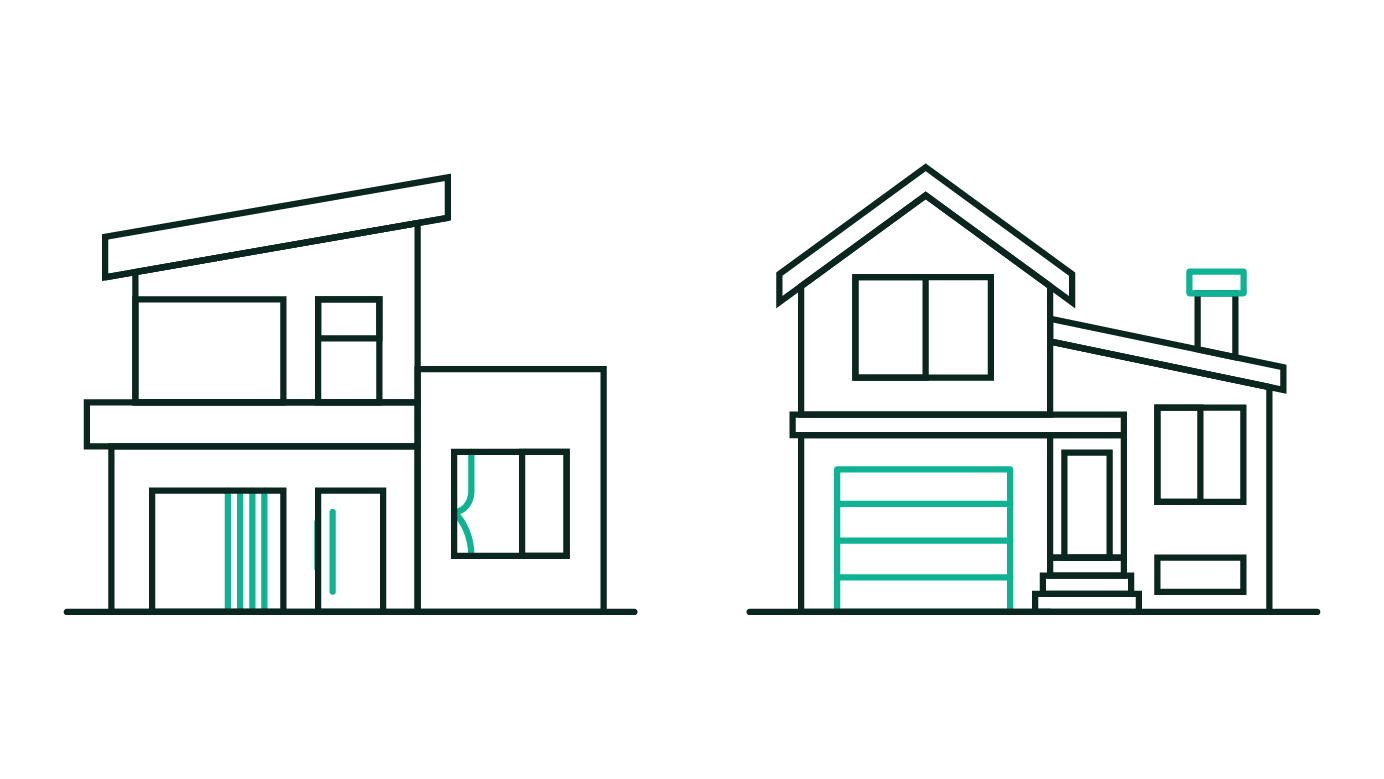
We live in the same world, yet each of us experiences a completely different version of it.
Even if we live on the same street, we interact with the neighborhood through our own unique lens. We notice different shops, choose different cafés, and read the area based on our individual habits. Fundamentally, our background, culture, and personal knowledge dictate how we interpret our surroundings.
The illusion of shared language
When we communicate through words alone, this psychological gap widens dramatically. We might hear the same sentence, but each of us immediately builds a custom image to match it inside our minds.
Let's test an example.
Imagine I verbally describe a house to three friends:
"It's a two-story house with a solid wooden door. It features an open lounge and kitchen leading out to a veranda and a small garden. Inside, a staircase with a lightwell leads to the upper floor, where you'll find three bedrooms and a bathroom."
Because they heard the exact same words, there will be some basic commonalities. But under the surface, their mental models will completely diverge.
One friend will imagine a hyper-modern space with plain white walls, sharp angles, and sleek grey tiles. Another will picture an old-school cozy setup with thick carpeted floors and bold, warm colors on the walls. The third might picture a rustic cottage, completely convinced there is a stone fireplace in the living room.
None of them are wrong. They just filled in the unsaid blanks using their own past experiences.
The AI prompt dilemma
If you want a modern version of this phenomenon, look no further than generative AI.
Almost everyone today has had the experience of typing a prompt into an AI image generator. You write out what you believe is a highly descriptive, crystal-clear sentence. You click generate, and the machine returns an image that is really far from what you actually had in mind.
Why? Because the AI interpreted your words literally through its own vast database, missing the unwritten context, the specific aesthetic, and the precise spatial layout you were visualising.
Words are open to interpretation. They carry an inherent margin of error.
Freezing interpretation gaps
Now, imagine I stop talking, and simply show those same three friends a photograph of the actual house.
Instantly, the mental guesswork stops. Everyone is suddenly looking at the same reality. Because when we share a concrete visual reference point, it leaves no room for interpretation, confusion, or personal bias.
In a casual conversation over dinner, these divergent mental houses don't really matter. It’s just harmless imagination.
But now imagine this same mechanic applied to the way we work inside an organisation.
The silent growth of clarity debt
What happens when an unwritten rule, a critical workspace structure, or an informal decision made quickly while walking out of a meeting room is left entirely to verbal memory or text-heavy emails?
Every person on the team walks away, treats the text like an ambiguous prompt, and quietly builds their own version of that "house" in their head. They start pulling in slightly different directions, operating under entirely different assumptions.
This is exactly how clarity debt builds up. It happens slowly, and it happens quietly.
It goes completely unnoticed for months, wasting a little bit of time, energy, and money here and there through repetitive trials and errors. By the time the misalignment finally surfaces, you aren't just dealing with a minor misunderstanding anymore; you are dealing with a major structural breakdown.
Amongst a group of people who are supposed to work toward a single, shared purpose, having a visual source of truth changes everything.
If you want your team to stop managing by guesswork, you have to stop writing longer descriptions. You need to show them the map.